Ground conditions in Nottingham can change dramatically in the space of a mile. You get the firm Sherwood Sandstone under Mapperley Park — great for bearing, predictable. Then you cross the Trent into West Bridgford and hit soft alluvial clays that can be 10 metres deep before you find anything competent. We see this contrast daily in the CPT test data our rigs pull from sites across the city. A cone penetration test cuts through the guesswork. You get a continuous profile of tip resistance and sleeve friction, logged digitally every centimetre. For a city built on the Triassic sandstone scarp but crisscrossed by river terraces and buried channels, that level of detail matters. It tells you exactly where the weak lenses sit, and that shapes everything from pile depth to settlement calculations. Our lab team in Nottingham processes the raw cone data alongside grain size analysis from any borehole samples, giving you a correlated ground model that stands up to building control review.
A continuous cone trace across Nottingham's buried river terraces can reveal soft spots that a borehole every 15 metres would miss entirely.
Service characteristics in Nottingham
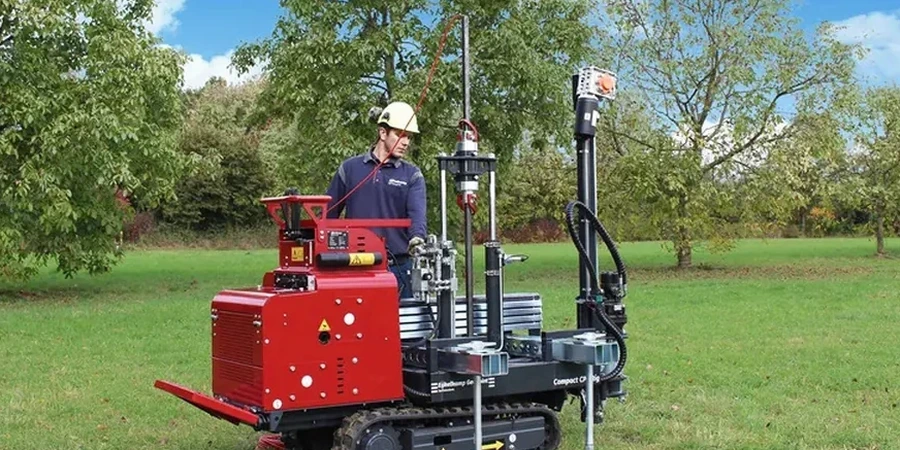
Field demonstration
Risks and considerations in Nottingham
The winter of 2023-24 was one of the wettest on record in the East Midlands. Groundwater in the Trent floodplain rose sharply, saturating the superficial deposits. That changes everything for a CPT rig. If you run a cone test in dry summer conditions and don't account for what happens when the water table climbs, your effective stress parameters are fiction. We pulled data from a site near Colwick in February where the u2 readings were double the summer baseline. The client's original foundation design — based on desk study assumptions — had to be revised with deeper piles and a stiffer mat foundation solution. The cone data made the case for that change undeniable. Nottingham's post-industrial land also hides surprises: old backfilled marl pits around Sneinton, undocumented fill behind Victorian retaining walls near The Park. A CPT rig can push through that disturbed ground and tell you where the natural strata really begin. Relying solely on trial pits or window samples in those zones leaves you exposed.
Our services
Our CPT rigs are set up to handle Nottingham's specific access constraints — tight city centre plots, rear extensions with narrow side access, and brownfield sites with unknown buried obstructions. Each sounding delivers a calibrated data set you can put straight into your design model.
Piezocone (CPTu) Soundings
Full cone penetration test with pore pressure measurement. Essential for the soft alluvial clays of the Trent Valley. We log u2 dissipation curves to derive consolidation parameters.
Seismic CPT
Equipped with a geophone array to measure shear wave velocity (Vs) directly. Useful for seismic site class determination on the sandstone scarp and for liquefaction assessment in saturated granular deposits.
Dissipation Testing
Stopped penetration at critical depths to monitor pore pressure decay. Gives you the coefficient of consolidation and helps define drainage conditions during loading.
Abrasion-Resistant Cones
Hardened cones for pushing through the Mercia Mudstone weathered zone and gravelly terrace deposits. Prevents premature tip wear that would corrupt the qc record.
Common questions
How deep can a CPT rig penetrate in Nottingham's sandstone?
In the Sherwood Sandstone, refusal typically occurs between 15 and 25 metres depth, depending on cementation. Our 20-tonne rig can handle the weathered zone well, but massive sandstone beds will stop the push. For deeper investigations into bedrock, we combine CPT with rotary boreholes.
What is the cost range for a CPT test in Nottingham?
A standard CPT sounding in Nottingham costs between £120 and £220 per metre, depending on depth, access requirements, and whether piezocone or seismic modules are added. Mobilisation is priced separately based on site location and setup time.
Do you need to close roads or pavements for CPT testing?
Our tracked CPT rig can access most urban sites through a standard garden gate or side passage — it's about 1.5 metres wide. For highway or pavement soundings, we handle the Nottingham City Council permit process and can work within lane closure or traffic management setups as required.