Nottingham's industrial past and its position straddling the River Trent mean we encounter some of the most unpredictable ground conditions in the East Midlands. The alluvial clays, silts, and pockets of undocumented historic fill across the Trent Valley can turn a straightforward foundation design into a headache when bearing pressures exceed what the native soil can handle. With over 320,000 people living in the urban area and major regeneration projects reshaping the city, demand for reliable ground improvement keeps growing. Stone columns offer a proven way to reinforce these weak deposits without deep piling. By installing compacted granular columns on a grid pattern, we transfer loads through the soft layer to more competent strata, reducing total and differential settlement. The technique works particularly well beneath embankments, industrial slabs, and medium-rise residential blocks where vibro-displacement methods can densify the surrounding soil. For sites near the river where groundwater sits high, we often pair the treatment with a CPT test to verify column integrity and confirm the densification radius achieved.
A well-executed stone column grid can halve settlement and double bearing capacity in Nottingham's alluvial deposits without removing a single cubic metre of soil.
Service characteristics in Nottingham
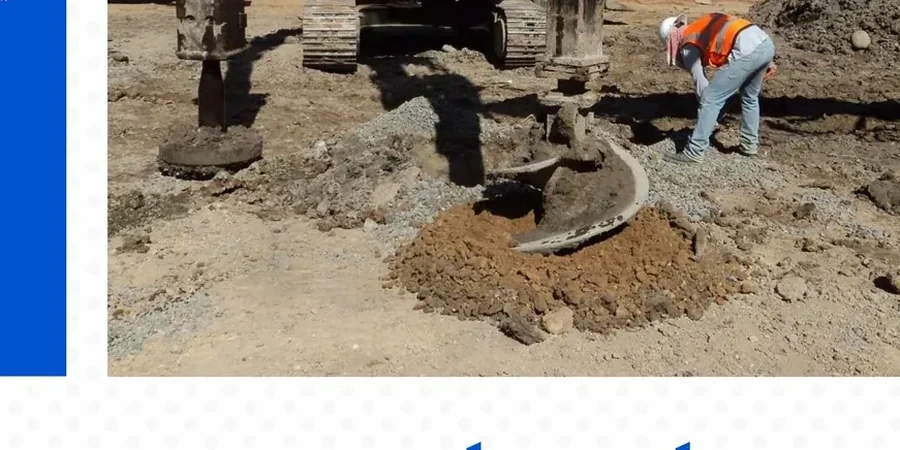
Risks and considerations in Nottingham
Nottingham sits at roughly 61 metres above sea level near the city centre, but the real risk lies below ground. The superficial geology maps show thick sequences of Holme Pierrepont Sand and Gravel overlying Mercia Mudstone, yet the top five metres are frequently soft alluvium and made ground with SPT blow counts below 6. If you skip a proper ground investigation and assume competent bearing at formation level, you are gambling with differential settlement that can crack slabs and distort steel frames within the first two years. We have seen projects where the client proceeded without treatment and ended up spending three times the original ground improvement budget on remedial underpinning. The cost of stone columns is modest compared to the liability of underperforming foundations. During the design phase, we model the composite ground using unit cell theory, checking the stress concentration factor and radial drainage influence to ensure the treatment zone performs as predicted under both static and cyclic loading conditions.
Our services
Every stone column project in Nottingham starts with a desk study and site investigation to characterise the variability of the ground. From there we develop a treatment scheme that addresses the specific performance requirements of the structure. Our scope typically includes the following phases.
Feasibility assessment and preliminary design
Review of ground investigation data, identification of target treatment zones, and estimation of area replacement ratio, column spacing, and depth using analytical methods and settlement calculations per Eurocode 7.
Detailed design and specification
Production of layout drawings, column schedules, stone grading specifications, and acceptance criteria. Includes unit cell modelling to verify settlement reduction and bearing capacity improvement for the proposed loading.
Plate load testing and verification
Post-installation zone load testing on individual columns and between columns to confirm composite ground stiffness. Results are correlated with CPT profiles to validate the design assumptions and sign off the treated platform.
Common questions
What typical cost range should I budget for stone column design and installation in Nottingham?
For a typical residential or light commercial project in the Nottingham area, stone column design and installation usually falls between £1,300 and £3,950 depending on the treated area, depth of soft soil, and number of columns required. Access constraints and the need for pre-treatment ground investigation will influence the final figure.
How deep can stone columns go in the Trent Valley ground conditions?
In Nottingham's alluvial deposits we routinely install columns to depths between 4 and 12 metres. The limiting factor is usually the presence of dense gravel layers or the Mercia Mudstone bedrock. We select the vibroflot power and stone feed method based on the depth and the groundwater regime encountered during the site investigation.
How do you verify that the stone columns are performing as designed?
We use a combination of real-time installation monitoring and post-treatment verification. During installation we record amperage, penetration rate, and stone consumption per lift. After curing, we perform zone plate load tests and CPT soundings through the treated ground to confirm that the stiffness and density targets have been met.
Can stone columns be installed right next to existing buildings without causing damage?
Yes, but it requires careful planning. We monitor vibration levels with geophones on adjacent structures and adjust the vibroflot frequency and lift height to stay within safe limits. For sensitive heritage structures, which Nottingham has in abundance, we often switch to a bottom-feed system that reduces lateral vibration transmission.