A residential scheme near the River Trent floodplain showed 8 metres of loose fine-to-medium sand before hitting the competent Sherwood Sandstone Group—classic Nottingham geology. The developer had already ruled out piling on cost grounds, but settlement predictions under strip footings were exceeding 40 mm. Our team proposed a vibrocompaction design grid at 2.5 m triangular spacing, targeting a relative density above 70% across the full loose layer. We verified the treatment with pre- and post-compaction CPT testing, measuring cone resistance jumps from 4 MPa to over 12 MPa in the target zone. Nottingham sits on a mix of Mercia Mudstone outcrops and Quaternary river terrace deposits, and the contrast between competent rock and liquefiable sand lenses is sharper than most engineers assume. A proper compaction design here means correlating SPT N-values from the SPT drilling campaign with the energy input per probe, adjusting spacing where silt lenses appear.
On Nottingham's river terraces, a 0.5 m grid adjustment can mean the difference between 65% and 85% relative density—and that gap dictates whether your foundation settles 15 mm or 45 mm.
Service characteristics in Nottingham
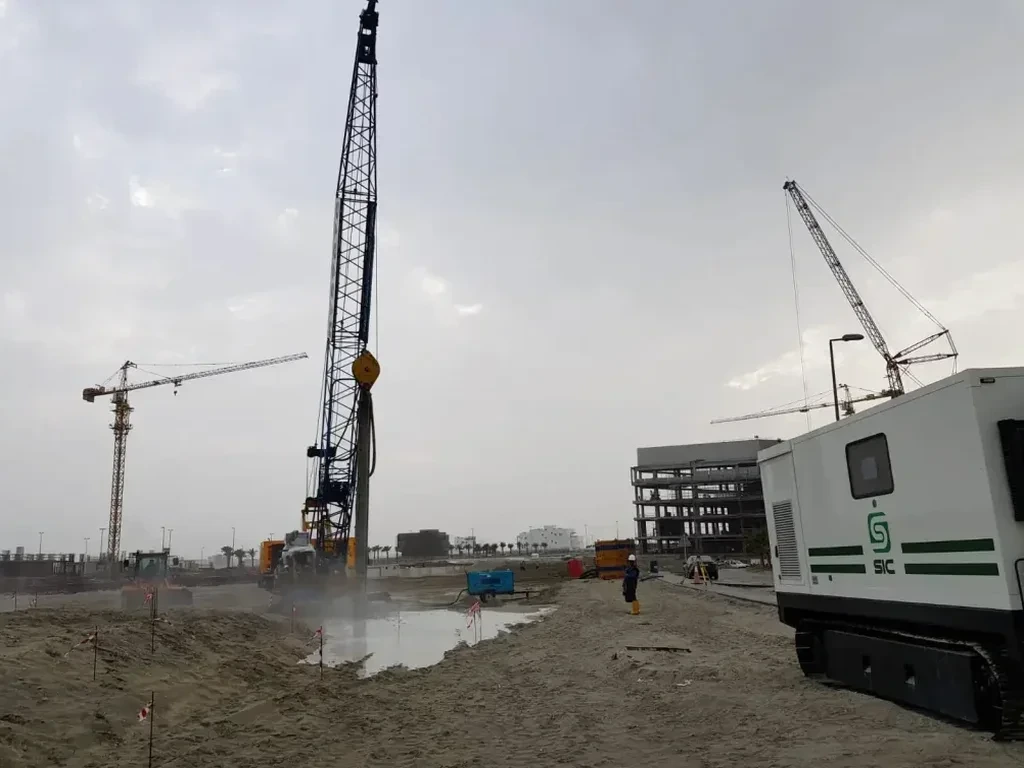
Field demonstration
Risks and considerations in Nottingham
BS EN 1997-1:2004 Section 6 and BS 5930:2015 set the framework, but Nottingham's river terrace deposits introduce a risk profile that generic ground improvement specifications miss. Loose sand lenses below the water table—common between Trent Bridge and Colwick—are susceptible to cyclic mobility under seismic loading, even though the UK is a low-seismicity region. An incomplete compaction grid leaves untreated columns of sand that can trigger differential settlement of up to 25 mm across a single building footprint. The deeper risk is over-compaction in zones where the Sherwood Sandstone rises abruptly: driving the vibrator into weathered rock fractures the formation and creates preferential drainage paths that undermine adjacent footings. We mitigate this by mapping the rockhead contour from CPT refusal depths at every fifth probe location, then adjusting the treatment depth dynamically. A single skipped verification borehole has, in our experience, resulted in post-construction settlement requiring underpinning—a cost multiplier no Nottingham developer wants to face.
Our services
Our vibrocompaction design package covers the full Nottingham project lifecycle, from feasibility through post-treatment verification. Each service references the relevant British Standard and is calibrated to the Sherwood Sandstone overburden conditions.
Compaction Grid Design & Energy Specification
Spacing, depth, vibrator power, and amperage envelope defined from site-specific CPT and SPT data. Includes settlement prediction using Schmertmann and Burland methods calibrated to Nottingham sand compressibility.
Pre- and Post-Treatment CPT Verification
Cone penetration testing on a 5 m staggered grid before and after vibrocompaction, with qc, fs, and pore pressure logs. Acceptance per BS EN 1997-2 Annex D criteria.
Hybrid Vibrocompaction & Stone Column Design
For sites with silt lenses exceeding 15% fines content. Vibrocompaction in clean sand zones, gravel columns through interbedded silts, with load transfer analysis across the transition.
Settlement Monitoring & As-Built Reporting
Surface settlement plates, deep extensometers, and periodic topographic surveys during and after treatment. Final report with zone-by-zone Dr maps and compliance statement.
Common questions
What depth of loose sand can vibrocompaction treat in Nottingham?
In Nottingham's river terrace deposits, we routinely treat depths between 6 and 14 metres. The lower limit is typically controlled by refusal on the Sherwood Sandstone bedrock. The upper limit depends on the fines content: above 15 percent silt, vibration alone becomes inefficient and we recommend a hybrid stone column approach. The specific depth for your site is confirmed through CPT profiling before design begins.
How much does a vibrocompaction design package cost for a Nottingham site?
For a typical Nottingham residential or light industrial site, the complete design package—including grid layout, energy specification, pre- and post-treatment CPT verification, and as-built reporting—ranges from £1,320 to £4,610 depending on treatment area, number of verification CPTs, and whether hybrid stone column design is required. This excludes the compaction execution itself, which is tendered separately.
How do you verify that compaction has reached the target density?
We use pre- and post-treatment CPT pairs across a 5-metre staggered grid. The acceptance criterion is a cone resistance qc of at least 10 MPa or a relative density above 70 percent, whichever is more conservative for the zone. We also check friction ratio trends to confirm that fines haven't migrated during water jetting. All verification follows BS EN 1997-2 and BS 5930:2015.