Nottingham sits on a complex geological mix of Mercia Mudstone and Quaternary river terrace deposits. The River Trent cuts through the city centre and the Leen Valley adds further alluvial complexity. Seismic hazard here is low by global standards but not negligible. The British Geological Survey maps several local fault lines. Eurocode 8 classifies the region's ground type as variable. This matters for structural resilience. Base isolation seismic design separates a building from ground motion. It is not just for high-seismic zones. It protects investment and ensures operational continuity. We apply this technique on soft Trent Valley soils where amplification can surprise engineers. The MASW method helps map shear wave velocity before any isolation system is specified. A proper CPT test reveals the stratigraphy needed to model ground response accurately.
On Nottingham's alluvial corridors, decoupling a structure from ground motion is often cheaper than post-event downtime.
Service characteristics in Nottingham
Risks and considerations in Nottingham
We reviewed a mid-rise residential project on the old Boots Island site near the Trent. The developer saw seismic design as a box-ticking exercise. Initial fixed-base calculations passed minimum code checks. But the ground investigation showed 12 metres of soft silty clay over mudstone. Ground motion amplification was significant. Without base isolation seismic design the inter-storey drift would have damaged partitions and glazing even in a moderate event. The repair cost would have dwarfed the isolation system outlay. The real risk is not collapse. It is loss of function. A building declared unsafe for weeks is a liability. Nottingham's expanding bioscience and tech clusters cannot afford operational shutdown. The cost-benefit case for isolation writes itself once downtime enters the equation.
Our services
Our Nottingham base isolation seismic design workflow covers the full project lifecycle. We start with site characterisation and finish with construction oversight.
Seismic Hazard Assessment
Site-specific response spectra and ground motion time series selection for Nottingham city centre and Trent Valley postcodes.
Base Isolation Seismic Design
Nonlinear analysis, isolator specification, and peer review preparation. We deliver a complete design package for Category II and III structures.
Prototype Testing Oversight
Witnessing EN 15129 production tests at European laboratories. We verify stiffness, damping, and durability before isolators ship to site.
Common questions
Is base isolation worth it in a low-seismicity city like Nottingham?
It depends on the building's function and soil conditions. On the soft alluvium of the Trent floodplain, ground motions amplify. A base isolation seismic design can cut floor accelerations by more than half. For laboratories, data centres, or emergency facilities the business case is strong. The premium is typically 2% to 5% of structural cost.
What isolator types suit UK buildings?
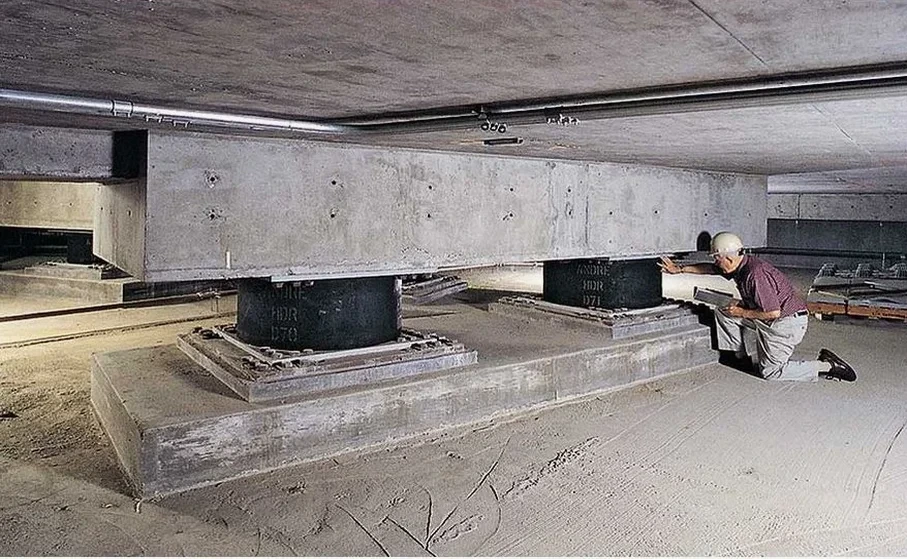
High-damping rubber bearings (HDRB) and lead rubber bearings (LRB) are common because they self-centre. Friction pendulum systems (FPS) work well on stiff Mercia Mudstone sites. We select based on the soil profile from the ground investigation.
How does the design process integrate with UK building regulations?
Our designs comply with Approved Document A and BS EN 1998-1. For complex structures we follow the peer review process defined in the UK National Annex. We coordinate directly with building control bodies.
What does base isolation seismic design cost for a typical Nottingham project?
For a mid-rise building the design fee and isolator supply typically range from £3,480 to £6,700 depending on the number of bearings and the analysis complexity. A fixed-price proposal follows the initial site review.
Do you need special site investigation data for isolation design?
Yes. Standard SPT data is not enough. We need shear wave velocity profiles from MASW or cross-hole testing. CPT data is essential to define the soil layering accurately. The better the ground model, the more efficient the isolation system.