When a site investigation hits the silty fine sands of the Trent floodplain, standard classification falls short. The difference between a well-graded and a uniformly graded soil dictates drainage design, frost susceptibility, and fill suitability under Nottingham's variable groundwater regime. We run the full particle size distribution curve—dry sieving from 75 mm down to 63 µm, then hydrometer sedimentation into the clay fraction—so the ground model reflects what the borehole actually encountered. Results feed directly into permeability estimates and compaction control, particularly where reworked Sherwood Sandstone produces unexpected fines content. Complementing a CPT test with laboratory gradation reveals whether low cone resistance stems from loose packing or genuinely high silt content—a distinction that changes the foundation strategy entirely.
A single grain size curve from Nottingham's alluvial deposits often explains more about bearing behaviour than three SPT blows ever could.
Service characteristics in Nottingham
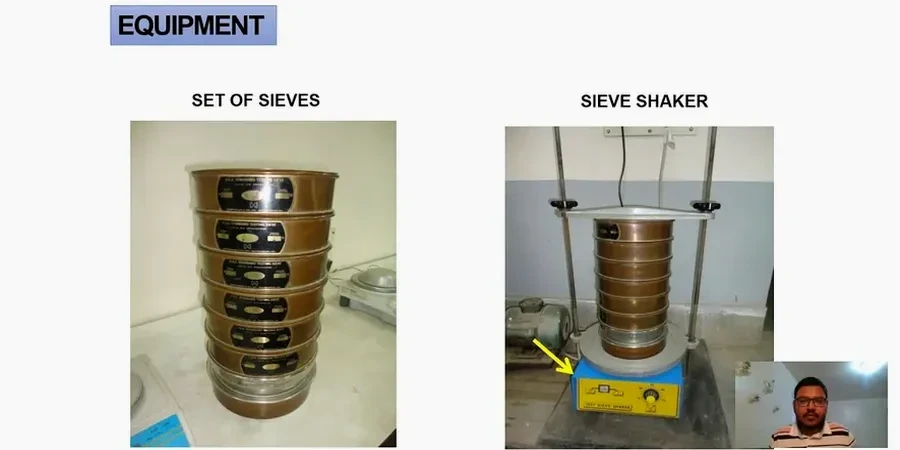
Field demonstration
Risks and considerations in Nottingham
A residential scheme on the northern fringe of Nottingham specified imported granular fill for frost protection beneath floor slabs. The contractor substituted a local quarry sand assuming it met the 6F2 grading envelope, but the material contained 22% fines passing 63 µm—well above the 15% threshold. Capillary rise through that layer wicked groundwater into the insulation during the first winter, triggering condensation and floor heave complaints. A single hydrometer test before placement, costing a fraction of the remedial screed replacement, would have identified the silty nature of the sand and redirected it to non-structural fill. Nottingham's combination of shallow groundwater in the Trent Valley and patchy made ground means particle size distribution is not an academic exercise; it is the cheapest insurance against moisture-related failure in buried services and sub-base layers.
Our services
Our Nottingham laboratory handles everything from single jar samples for classification checks to full-production grading suites for earthworks compliance. Each test runs with the same calibration rigour whether it is a 10-metre deep Sherwood Sandstone sample or a surface fill from a brownfield site in the city centre.
Combined Sieve and Hydrometer Suite
Full particle size distribution from coarse gravel down to the clay fraction. Includes oven-drying, dry sieving through BS sieves, and sedimentation hydrometer analysis with temperature-corrected readings. Delivers the complete grading curve with Cu and Cc for classification to BS 5930.
Wet Sieving for Silty and Clayey Soils
When fines content exceeds 10%, dry sieving underestimates the sand fraction. We wash the sample through a 63 µm sieve, oven-dry the retained material, and sieve it mechanically. The wash-water is collected and dried to quantify total fines—essential for Nottingham's alluvial silts.
Hydrometer-Only Analysis for Fine-Grained Soils
For clays and silts where the entire sample passes the 2 mm sieve. Sedimentation analysis using a 152H hydrometer, with dispersant and temperature correction, producing a continuous curve from 63 µm to approximately 2 µm. Ideal for Mercia Mudstone weathered zones.
Common questions
How much does a grain size analysis cost in Nottingham?
A combined sieve and hydrometer test typically ranges from £90 to £140 per sample, depending on the number of sieves required and whether wet preparation is necessary. High-fines samples needing extended sedimentation readings may sit at the upper end. We provide a firm quote once we know the expected soil type and the number of samples.
Do you need a hydrometer test if the soil looks sandy?
Visual classification can mislead, especially with Nottingham's silty fine sands where fines content sits between 10% and 25%. A hydrometer test quantifies the silt and clay fraction precisely. This number determines frost susceptibility and drainage behaviour; skipping it on a 'sandy' sample often leads to sub-base failure later.
Which British Standards govern particle size testing?
Sieve analysis follows BS EN 933-1 for aggregates and BS 5930 for soils. The hydrometer method adheres to BS EN ISO 17892-4:2016. For earthworks compliance, the Specification for Highway Works Series 600 tables define grading envelopes that we check against directly.
How long does a full sieve and hydrometer test take?
Turnaround is typically three to five working days from sample receipt. The hydrometer phase requires 24-hour sedimentation readings at minimum, and oven-drying coarse fractions adds further time. We can expedite to 48 hours for urgent projects where preliminary grading data is needed ahead of the final report.