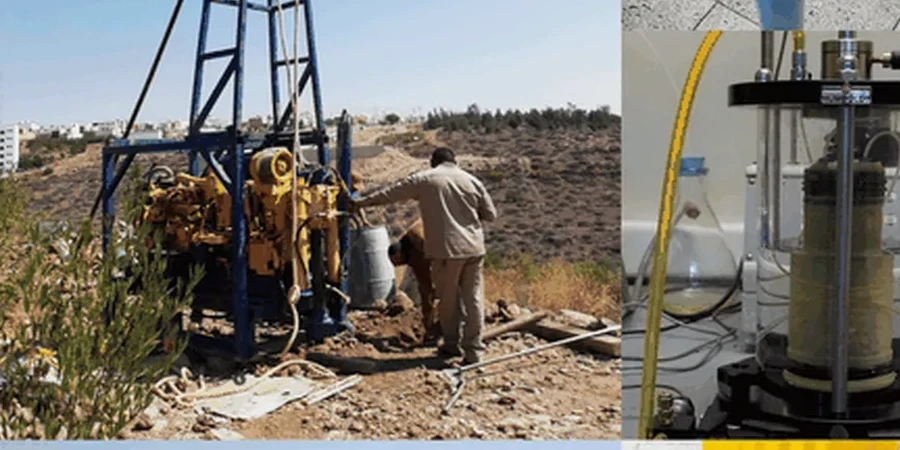
A tracked percussion drilling rig sets up on a brownfield site near the River Leen, its sampling tubes pushing through weathered sandstone to retrieve undisturbed cores. That rig, and the laboratory team waiting to receive those samples, represents the front line of a thorough soil mechanics study. Nottingham's ground profile rarely conforms to a single textbook description. Within a few hundred metres you can transition from the competent Sherwood Sandstone of the Castle Rock outcrop to the over-consolidated Mercia Mudstone that underlies much of the city centre, and then into the softer alluvial silts and gravels of the Trent floodplain. Each unit behaves differently under load, responds differently to changes in moisture, and demands its own set of engineering parameters. The study quantifies that variability — shear strength, compressibility, permeability, and stiffness — so that foundation designs are grounded in real measured values rather than conservative assumptions that inflate construction costs. For deeper sites where bedrock depth varies unpredictably, we often pair the investigation with a trial pitting programme to map the drift-bedrock interface across the footprint before committing to piling or raft solutions.
Nottingham's ground shifts from sandstone ridge to soft alluvium within a single site boundary — a soil mechanics study captures that transition before it becomes a construction claim.
Service characteristics in Nottingham
Risks and considerations in Nottingham
The Mercia Mudstone Group that underlies large areas of Nottingham behaves deceptively. Freshly excavated it can look like competent rock, but exposure to air and water triggers rapid slaking and swelling. A soil mechanics study that skips swelling pressure testing on this material risks specifying foundation depths that later experience heave damage. Equally problematic is the Sherwood Sandstone's variable cementation — strong enough to require rock coring in one borehole, yet friable enough to wash out under high groundwater flow in the next. The Trent Valley alluvium introduces a different hazard: pockets of peat and very soft organic clay buried beneath a metre or two of stiffer surface crust. Cone penetration testing across the floodplain near Colwick and Lady Bay has revealed undrained shear strengths below 20 kPa in these lenses, requiring piled foundations or ground improvement where conventional strip footings would settle unacceptably. The investigation programme must be dense enough to catch those pockets — a single borehole every 30 metres is often insufficient on fluvial deposits.
Our services
The soil mechanics study is delivered as an integrated package from site investigation through to parameter selection. Each component addresses a specific engineering question that Nottingham's ground conditions raise.
Rotary drilling and sampling in Sherwood Sandstone
Triple-tube wireline coring recovers intact sandstone cores for unconfined compressive strength testing, point load index, and assessment of fracture spacing and infill. Where the sandstone is weakly cemented, SPTs with split spoon samplers provide disturbed samples for classification and relative density estimates.
Advanced laboratory testing on Mercia Mudstone
Swelling pressure oedometer tests, consolidated undrained triaxial compression with pore pressure measurement, and fully softened shear strength determination. These parameters are essential for designing deep basements and cut-and-cover tunnels in Nottingham's city centre, where the mudstone is the primary founding stratum.
Foundation parameter derivation and GDR
Statistical analysis of all test results to derive characteristic values per Eurocode 7, including bearing capacity factors, shaft adhesion for piles, and modulus of subgrade reaction for raft design. The Geotechnical Design Report presents these with clear commentary on the geological model, making it actionable for the structural engineer.
Common questions
How much does a soil mechanics study cost for a typical Nottingham residential development?
For a small to medium residential scheme — say two to four boreholes to 15 metres depth with associated laboratory testing and a Geotechnical Design Report — the soil mechanics study typically falls in the range of £2,190 to £4,620. The final figure depends on access constraints (many Nottingham backland sites need compact rigs), the depth to competent bearing strata, and the number of triaxial or oedometer tests the structural engineer specifies.
How long does a soil mechanics study take from mobilisation to final report?
Site work for a typical Nottingham investigation finishes within three to five working days, assuming reasonable access and no buried obstructions. The laboratory programme runs concurrently and takes two to three weeks for standard classification and strength tests; consolidation and swelling tests on Mercia Mudstone add another five to seven days. The interpretive Geotechnical Design Report is usually delivered four to five weeks from rig mobilisation.
What depth of borehole is needed in Nottingham?
Borehole depth is governed by the foundation type and the geology. On the Sherwood Sandstone ridge, 10 to 15 metres often suffices for shallow foundations. In the Trent Valley alluvium, where piles are common, boreholes typically extend 20 to 30 metres to prove competent bedrock. BS 5930's rule of thumb — boreholes should extend to a depth where the stress increase from the foundation is less than 10% of the in-situ effective stress — is always applied, but site-specific pile group analysis may demand deeper investigation.
Is a soil mechanics study mandatory for building control approval in Nottingham?
Nottingham City Council's building control department, like all UK local authorities, requires adequate ground investigation to demonstrate compliance with Approved Document A (Structure). Without a site-specific soil mechanics study that provides design parameters to Eurocode 7, the structural engineer cannot justify foundation depths or bearing pressures. For larger schemes, the planning condition may explicitly require a Phase 2 geo-environmental and geotechnical investigation before any above-ground works commence.