The CPT rig we mobilise around Nottingham is a 20-tonne tracked unit with a 200 kN penetration capacity, ideal for profiling the stiff glacial tills and weathered mudstone that define the city's slopes. Working along the Trent Valley and up into the sandstone ridges of the suburbs, we push piezocone probes to 25 metres to map pore pressure and tip resistance before cutting a single bench. Nottingham averages 710 mm of rainfall annually, and those wet winters saturate the near-surface clay, so we combine CPT logs with borehole shear vanes to pin down the strength envelope accurately. The rig's stabilisers level out on the 1:3 gradients we encounter behind West Bridgford and Basford, letting us position test points within two metres of the crest without compromising safety.
A slope in weathered Mercia Mudstone can look stable for a decade and then mobilise after one exceptionally wet winter — it is the pore pressure, not just the geometry, that governs the factor of safety.
Service characteristics in Nottingham
Risks and considerations in Nottingham
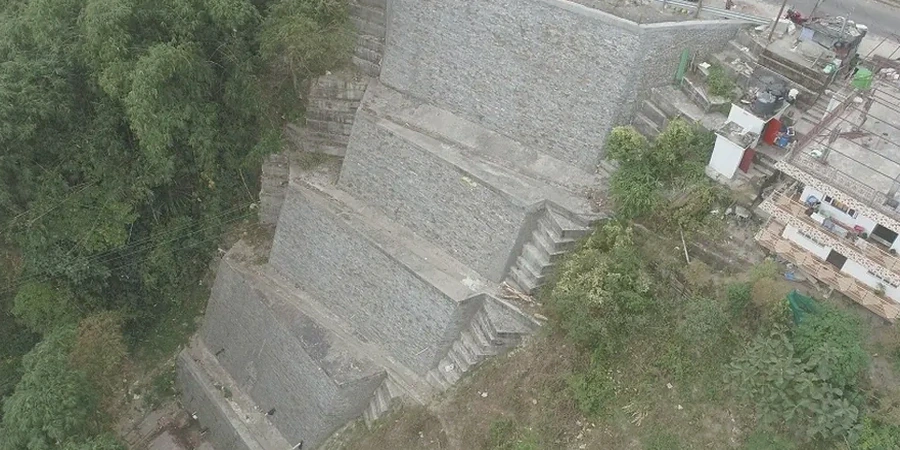
Nottingham's Victorian expansion pushed terraced housing up onto the steeper valley sides of the Leen and Trent, and those 19th-century cuttings were excavated with no engineered drainage. Today, many of those slopes back gardens directly onto public highways or railway corridors. A shallow rotational failure in a 4-metre cutting can undermine a Network Rail boundary fence within hours. The risk is compounded by leaking combined sewers — the city still has over 200 km of clay pipe that cracks with seasonal movement, feeding uncontrolled water into the slope. When we model stability here, we do not assume dry conditions; we run sensitivity analyses with a perched water table at 1.5 metres below ground level, because that is what we find in the standpipes in February. For slopes adjacent to the tram network or the M1 corridor, the consequence class pushes the design into a higher scrutiny level under BS EN 1990.
Our services
We tailor each stability assessment to the specific geological setting in Nottingham, pulling together field data, lab testing, and numerical modelling to deliver a design recommendation that the principal designer can rely on. Here are the core work packages:
Limit Equilibrium Back-Analysis
Using Spencer and Morgenstern-Price methods in Slide2 to calibrate strength parameters against existing slope performance observed in the field.
Pore Pressure Monitoring & Design
Installation of Casagrande and vibrating wire piezometers in Nottingham's glacial till and mudstone, with 6 to 12 months of seasonal monitoring before design finalisation.
Remedial & Regrading Design
Developing regrading profiles, drainage blankets, and soil nail layouts for failing cuttings, with FoS verification under the UK National Annex combination factors.
Common questions
What is the typical cost of a slope stability analysis in the Nottingham area?
For a single slope up to 10 metres high, with site investigation, lab testing, and limit equilibrium analysis, the cost typically ranges from £1,080 to £3,160 depending on access constraints, the number of sections analysed, and the extent of pore pressure monitoring required.
How long does a full slope stability assessment take from start to finish?
A straightforward assessment with a single borehole and lab testing can be completed in 4 to 5 weeks. If seasonal groundwater monitoring is required — which we strongly recommend in the Mercia Mudstone around Nottingham — the programme extends to 4 to 6 months to capture winter peak pore pressures.
Do you handle slopes affecting Network Rail or public highway assets?
Yes, we apply the consequence class framework from BS EN 1990 and the risk acceptance criteria required by Network Rail standard NR/L2/CIV/086. The analysis includes dynamic loading from rail traffic where relevant, and we coordinate with the asset owner's geotechnical team throughout.
What parameters do you use for the Mercia Mudstone in Nottingham?
We do not rely on generic values. Our approach uses site-specific effective strength parameters from consolidated-undrained triaxial tests on 100 mm diameter specimens. For preliminary analysis of Nottingham's weathered Mercia Mudstone, we often see effective cohesion in the range of 5 to 15 kPa and a friction angle between 22 and 28 degrees, but the final design parameters are confirmed only after lab testing.