Nottingham’s urban landscape hides a complex geology shaped by the River Trent and its tributaries. The city centre sits on thick alluvial deposits overlying the Mercia Mudstone Group, creating a two-tiered challenge for any underground excavation. When the tram network expanded, engineers faced precisely this: soft, water-sensitive clays and silts that complicate tunnel face stability. We have worked extensively on projects across the city, from the Lace Market to the Meadows, defining the geotechnical parameters that govern tunnel design. A CPT test provides a near-continuous profile of the soft strata, allowing us to map transitions from alluvium to weathered mudstone without losing resolution. Complementing this with a triaxial test under consolidated-undrained conditions gives us the effective stress parameters needed for settlement prediction. Our laboratory, operating under UKAS accreditation to ISO 17025, processes samples from across the East Midlands, applying Eurocode 7 principles to every stage of investigation. The goal is clear: characterise the ground so thoroughly that the tunnel boring machine or sequential excavation method is never surprised by what lies ahead.
In Nottingham, the difference between a successful tunnel drive and a face collapse often lies in correctly interpreting the transition zone between alluvium and Mercia Mudstone.
Service characteristics in Nottingham
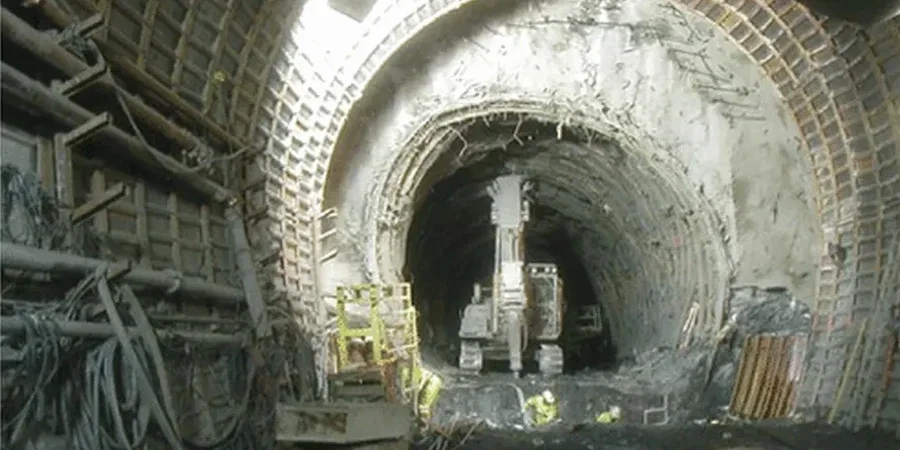
Risks and considerations in Nottingham
What we see repeatedly in Nottingham is that the interface between the alluvial cover and the Mercia Mudstone becomes the critical horizon. Groundwater perched at this boundary can transform a stable face into flowing ground within hours. Tunnel projects that underestimate the permeability contrast between the two units tend to encounter problems during rainy periods, when the River Trent is high and the floodplain aquifers recharge. The second major risk relates to stiffness. The alluvial clays are normally consolidated or lightly overconsolidated, meaning they compress significantly under unloading. When a tunnel opening is excavated, stress relief can induce larger-than-expected settlements at surface, affecting buildings on shallow foundations in areas like West Bridgford. We address this by running oedometer tests to determine compression and swelling indices, then deriving stiffness moduli for the relevant stress paths. A further concern is the presence of historic mine workings in the underlying Coal Measures. Though these are deeper, any tunnel that approaches the mudstone-coal interface must account for the possibility of collapsed pillars and altered stress regimes. Our site investigation planning always includes a desk study of abandoned mine plans from the Coal Authority.
Our services
The analysis programme we deliver for soft ground tunnel projects in Nottingham integrates field investigation, advanced laboratory testing, and parameter interpretation. Each service is configured to address specific geological units and design requirements.
Advanced triaxial testing for tunnel design
Consolidated-undrained and consolidated-drained triaxial tests on 38 mm and 50 mm specimens, with pore pressure measurement and stress path control. We define effective stress parameters (c', φ') and undrained shear strength (cu) for input into numerical models. Testing follows BS EN ISO 17892-9 and is tailored to the low confining stresses relevant to shallow urban tunnels.
One-dimensional compression and swelling
Oedometer testing on alluvial clays and weathered mudstone to determine compression index (Cc), swelling index (Cs), and preconsolidation pressure. These parameters govern settlement predictions above advancing tunnel faces. We load in small increments to capture the non-linear stiffness response of soft soils.
In-situ permeability profiling
Falling-head and constant-head tests in boreholes, plus laboratory permeability on triaxial specimens, to establish the hydraulic conductivity profile. Understanding groundwater flow through the alluvium-mudstone sequence is essential for dewatering design and face stability assessment during tunnelling.
Common questions
What is the typical cost of a geotechnical analysis programme for a soft soil tunnel in Nottingham?
The cost depends on the number of boreholes, the laboratory testing suite, and the complexity of parameter interpretation. For a preliminary design phase investigation in Nottingham, a programme including in-situ testing, triaxial and oedometer tests, and a factual report typically ranges from £3,510 to £11,480. Larger projects with multiple tunnel sections and more extensive sampling will fall at the higher end of this range. We provide a detailed proposal once we understand the tunnel alignment and geological setting.
Which BS 5930 tests are most relevant for Nottingham's Mercia Mudstone?
For the Mercia Mudstone, we specify point load strength index tests for rock strength classification, slake durability tests to assess sensitivity to wetting and drying, and consolidated-undrained triaxial tests with pore pressure measurement. BS 5930:2015+A1:2020 provides the framework for sample preparation and test selection. The mudstone can behave as a weak rock or a stiff soil depending on its weathering grade, so we often run both rock and soil classification tests on adjacent samples to capture the transition.
How do you handle the alluvium-mudstone interface during a tunnel investigation?
The interface is rarely a clean contact. We typically encounter a transition zone of weathered mudstone mixed with alluvial clay. Our approach is to log the interface in detail during cable percussion or rotary drilling, then sample at close intervals across the boundary. We run Atterberg limits, particle size distribution, and triaxial tests on specimens from both materials. The permeability contrast is assessed with in-situ tests in the alluvium and laboratory tests on mudstone core. This data allows the tunnel designer to model the interface as a distinct geotechnical unit rather than assuming a sharp boundary.
What ground investigation methods do you recommend before a tunnel project in Nottingham?
We recommend a phased investigation. Phase one should include a desk study of BGS mapping, Coal Authority mine records, and historical borehole data. Phase two involves cable percussion boreholes through the alluvium with U100 sampling, combined with CPTu soundings to define the soft soil profile continuously. Phase three, if required, adds rotary-cored boreholes into the Mercia Mudstone and underlying Coal Measures. In-situ permeability tests and geophysical methods such as seismic refraction help constrain the depth to bedrock and identify any buried channels in the Trent floodplain.