A common mistake in Nottingham construction is assuming the ground is uniform because the site looks flat. Developers break ground on a brownfield plot near the Lace Market, only to find buried cellars, old backfill, or sandstone at wildly varying depths—delays that could have been avoided with a simple exploratory test pit. An exploratory test pit is the most direct way to expose the subsurface, allowing an engineer to log strata, take undisturbed samples, and spot hazards before they become change orders. The city’s geology shifts dramatically in short distances: Triassic Mercia Mudstone in the city centre gives way to Sherwood Sandstone and Quaternary river terrace deposits along the Trent. In this environment, a borehole alone doesn’t always tell the full story. Our team uses machine-dug test pits to depths up to 4.5 metres, following BS 5930:2015 procedures for logging, sampling, and reinstatement, so the information you get is actionable. For deeper verification we often combine the pit observations with SPT drilling to correlate shallow and deep conditions in a single campaign.
An exploratory test pit exposes the ground truth that borehole logs miss—especially in Nottingham’s mixed urban fill and sandstone terrain.
Service characteristics in Nottingham
Risks and considerations in Nottingham
Nottingham sits at roughly 60 metres above sea level, but the real number that matters is the 400-plus sandstone caves carved beneath the city centre over centuries. When an exploratory test pit is skipped, a contractor can punch through the roof of an uncharted cave or void, triggering a collapse that swallows plant, delays the programme, and triggers emergency street closures. The city’s industrial past also left a legacy of undocumented backfill: old brick pits along the Leen Valley, ash and clinker in former railway yards, and buried foundations from slum clearances of the 1960s. A test pit is the quickest way to confirm what the desk study hints at. We’ve opened pits on sites where the historical map showed nothing, only to find 3 metres of rubble overlying a perfectly intact sandstone—information that completely changed the foundation recommendation. Under CDM 2015, the principal designer needs this ground information to discharge their duties; without it, the residual risk sits squarely with the client.
Our services
Each exploratory test pit we open in Nottingham is part of a wider ground investigation package tailored to the site’s geology and the structure’s sensitivity. The following services are typically combined with pit investigations to build a complete geotechnical model:
Machine-Excavated Test Pits
The core service: pits up to 4.5 metres deep using rubber-tracked excavators for minimal ground disturbance, logged in detail to BS 5930, with photographic records and GIS-tagged locations.
In-Situ Density and Strength Testing
Hand penetrometer and shear vane tests carried out directly on pit walls and floor, giving immediate strength data for the weathered zone that SPTs often miss.
Combined Pit and Borehole Campaign
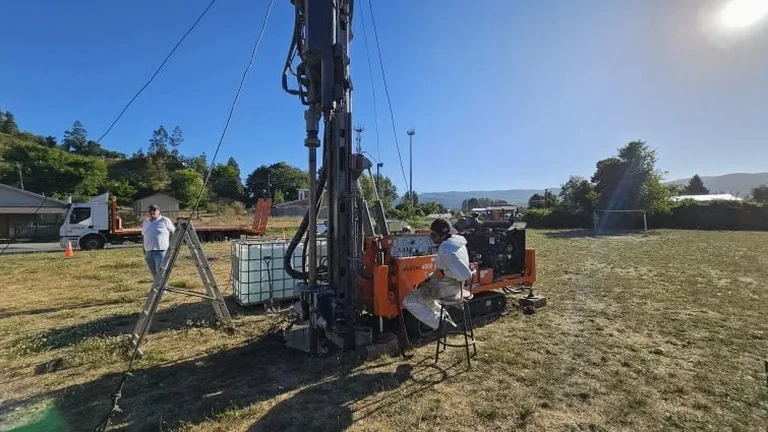
Test pits for the shallow 3-4 metres followed by dynamic sampling or rotary drilling on the same visit, so the shallow and deep profiles are correlated without mobilisation gaps.
Common questions
How much does an exploratory test pit cost in Nottingham?
For a standard machine-dug test pit to depths of 3-4 metres in accessible ground, including attendance by an engineer, logging, sampling, and reinstatement, the cost typically falls between £360 and £760 per pit. The final figure depends on site access, the number of pits in the campaign, whether a CAT scan is needed beforehand, and disposal costs if contaminated material is encountered. We provide a fixed-price quote after a brief site visit.
What depth of test pit do you need for a house extension in Nottingham?
For a typical two-storey extension, we aim for a pit depth of 2.5 to 3.0 metres, which is usually sufficient to reach the bearing stratum in most parts of Nottingham. Where the desk study suggests deeper fill—common in the Meadows or along old watercourses—we extend to 3.5 or 4.0 metres so the building control officer can see the bearing soil with their own eyes.
Can you dig test pits near the sandstone caves under the city centre?
Yes, but with extra precautions. Before any excavation near known or suspected cave zones, we review the BGS cave registry data and often commission a targeted GPR survey. The test pit is then excavated with a lighter machine and under constant engineering supervision, stopping if any void or loose roof section is exposed. The pit itself becomes a valuable inspection point for the cave’s condition.
How long does a test pit investigation take from start to report?
The fieldwork for two or three exploratory test pits is typically completed in one day. You receive a preliminary log and verbal summary before we leave site. The full factual report, complete with soil descriptions to BS EN ISO 14688, photographs, depth-to-water readings, and a site plan, is delivered within five working days. If you need the interpretive section with foundation recommendations, that adds approximately three days. More info.